Your phone buzzes next to your keyboard: a delivery photo of a box on your front step. You check the time and hope it’s still there when you get home in four hours.
It’s good to know your package arrived. It’s less comforting to know it’s sitting in plain view while you finish the workday.
“Delivered” is where the carrier’s responsibility ends and your package’s exposure begins. When I led SafeWise’s 2025 package theft research, we estimated that roughly 250,000 packages are stolen every day, adding up to nearly $15 billion in consumer losses a year. It’s still the most recent national estimate available.

Image: ZFLO
Even though awareness of porch piracy has grown, the standard advice hasn’t changed much. Most methods work before a theft (keeping packages out of sight or off the porch) or after it (alerts, footage, refund claims). Very few solutions act during a theft. That’s why we’ve all seen clip after clip of a thief staring into a camera while swiping a box, and why that footage so rarely brings the package back.
Here’s a look at how standard package theft solutions actually work, what part of the problem they solve, and how to cover the gaps.
How package theft actually happens
Package theft is a crime of opportunity, and the odds favor the thief. Packages sit in plain view, deliveries come and go predictably, and offenders usually get away with it — they’re rarely identified, let alone prosecuted.
Criminologist Ben Stickle, PhD, studied dozens of real porch theft videos and found that many thefts took under 30 seconds. The closer a home sat to the street, the more likely its package was to be stolen. And very few thieves bothered to hide their faces. Cameras, fences, and cars in the driveway didn’t seem to faze them.
So what makes a thief think twice? Read Hayes, PhD, of the Loss Prevention Research Council, boils effective deterrence down to three words: See, Get, Fear.
See: The offender has to notice the deterrent.
Get: They have to understand what it will do to them.
Fear: They have to believe it’s “a very real, clear and present danger to their criminal plan.”
Most package theft deterrents cover one or two of those steps. Very few cover all three.
Take cameras. A thief can see one, and most understand what it does. But a recording rarely leads to an arrest or a returned package, so there’s little to fear. That’s why doorbell cameras record package thefts far more often than they prevent them.
Other protection methods depend on things outside your control. A lockable package box only works if the driver uses it, closes it, and locks it (and if the package will fit). Signature requirements can fail when a carrier cuts corners, or when a well-meaning neighbor signs for your package and leaves it on your step. That doesn't mean your camera or lockbox is useless. It means you need to pay attention to which part of the problem each one actually solves and what vulnerabilities still exist.
The four layers of package protection
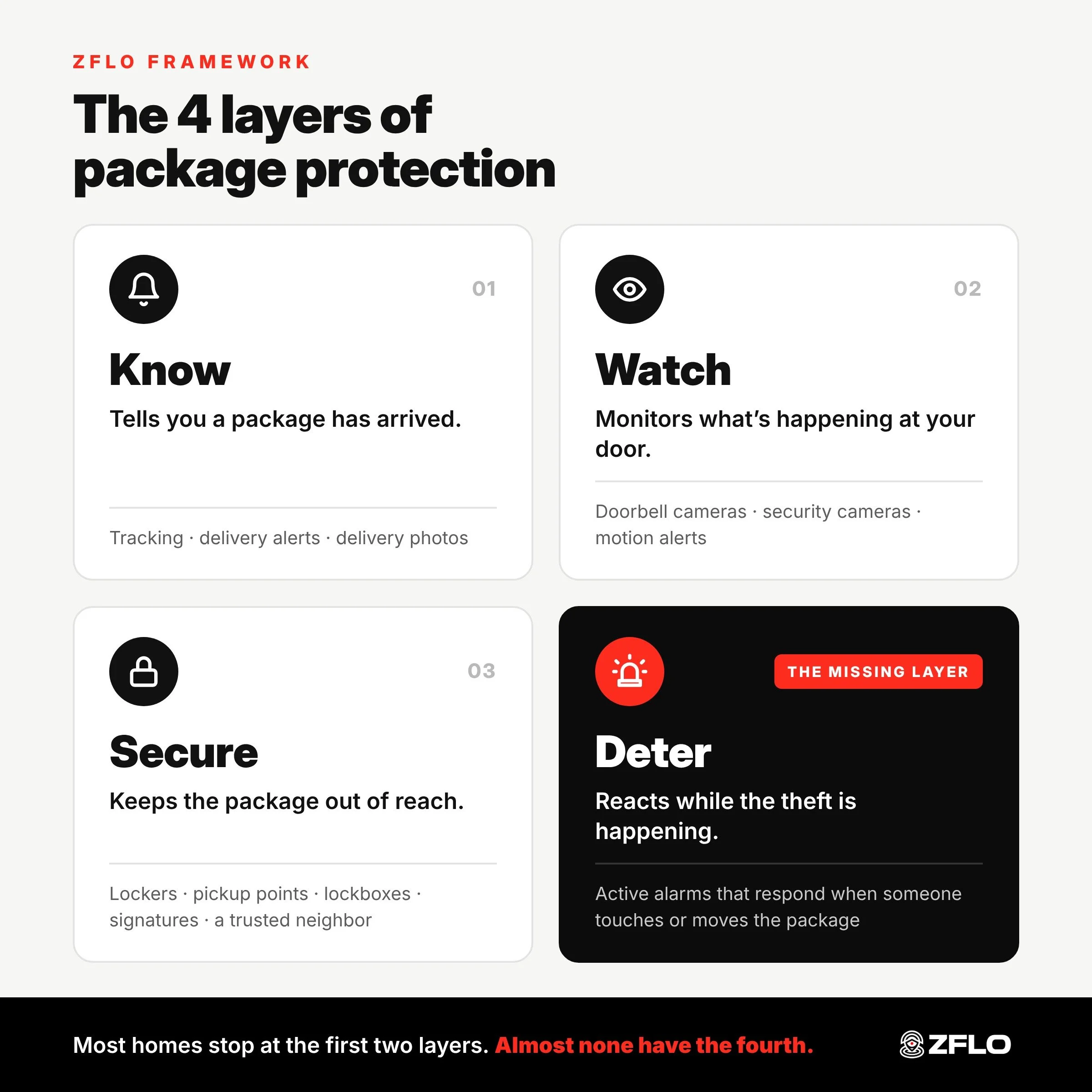
Image: ZFLO
Effective package protection is layered. The more layers you use, the better your chances of thwarting package thieves. We’ve identified the four must-have layers for effective package protection. Most methods only handle one or two.
The four layers at a glance
Know: Tells you a package has arrived (tracking, alerts, delivery photos).
Watch: Monitors what’s happening at your door (doorbell cameras, motion alerts).
Secure: Keeps the package out of reach (lockers, pickup points, lockboxes, signatures, a trusted neighbor).
Deter: Reacts when someone touches or moves the package, while the theft is happening.
The first three are familiar, and that’s where many people stop. But Know and Watch are passive: they tell you what happened. Deter is active: it acts while the theft is happening, and it’s the only layer that applies all of Hayes’s See, Get, Fear in the moment it matters most. The thief has to notice the deterrent, understand it, and decide the package isn’t worth the risk while their hand is still on the box.
Here’s how the most common prevention methods measure up.
Which prevention methods actually work
Most people don’t think about package protection until it’s too late. More than 8 in 10 theft victims added at least one deterrent after a package was stolen. Delivery tracking (52%) and security cameras or video doorbells (30%) are the most common. But how well do they, and the other popular options, handle the four layers?
Delivery alerts and tracking
Tracking tells you where your package is and when it lands. That’s where it stops. It can’t watch the package, secure it, or stop someone from taking it.
Covers: Know
Delivery photos
A delivery photo confirms when and where your package was left. It’s useful for a claim, but it can’t tell you what happened next.
Covers: Know
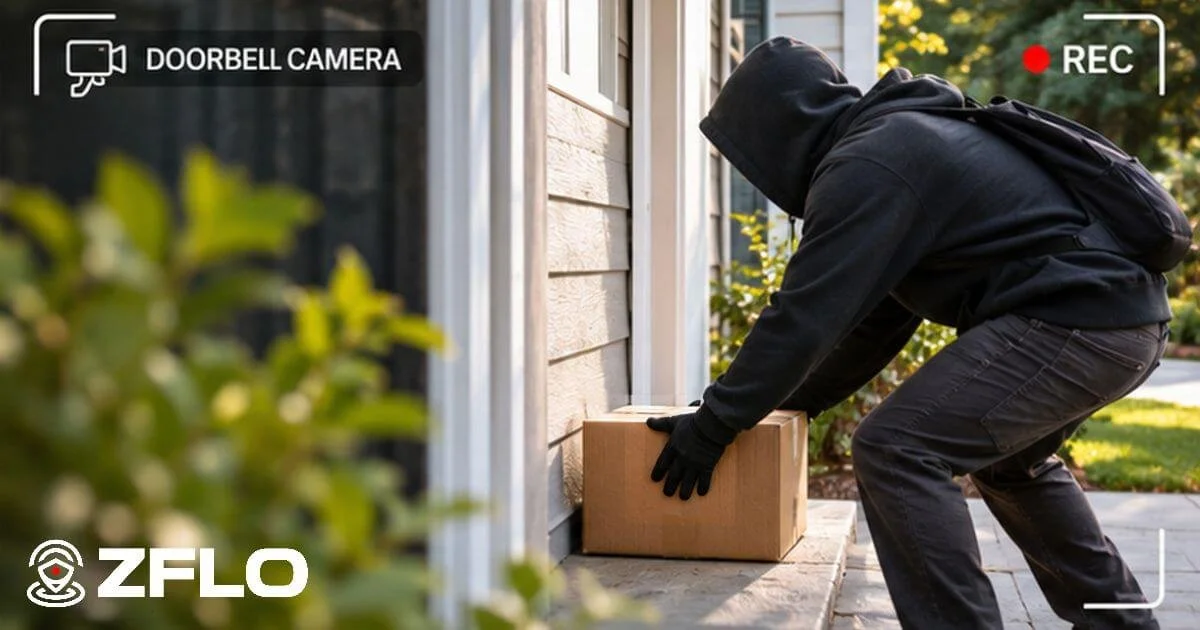
Doorbell cameras can help you get evidence that a package was stolen, but they don’t usually scare off a porch pirate. Image: ZFLO
Video doorbells and security cameras
Cameras are evidence tools. They record a theft, but rarely stop one. In Stickle’s research, most thieves didn’t even bother to hide their faces.
Covers: Know, Watch
Motion lighting and concealment
A motion light might startle a thief after dark, but three-quarters of package thefts happen during the day. Asking drivers to leave packages out of sight helps, but only if they follow your instructions, and a hidden package still isn’t a secured one.
Covers: Partial Deter (at night), partial Secure
Signature required
Requiring a signature puts the package in a person’s hands. But a carrier can cut corners, and a neighbor who signs for you might still leave the box on your step.
Covers: Secure (when it works)
A trusted neighbor
A neighbor who grabs your packages is a great safeguard, as long as they’re home when the truck comes.
Covers: Secure, sometimes Watch
Lockers, pickup points, and alternate addresses
Sending packages to a locker, a store, your workplace, or a family member removes the opportunity from this crime of opportunity. The trade-offs are an extra trip, and not every retailer or carrier offers these options.
Covers: Secure
Lockable package boxes
A lockbox gives you secure delivery without an extra trip, as long as your package fits and the driver uses it correctly. Pair it with a camera, and you cover two layers instead of one.
Covers: Secure (plus Watch, with a camera)
How the methods compare
Line them up, and the gap is easy to see: plenty of options to know, watch, and secure, and almost nothing that deters a thief in the act.
| Method | Know | Watch | Secure | Deter | Cost to shopper | Effort | Works when you're away? | Main limitation |
|---|---|---|---|---|---|---|---|---|
| Delivery alerts and tracking | Yes | — | — | — | Free | Low | Tells you, can't act for you | Information only |
| Delivery photos | Yes | — | — | — | Free | None | Yes | Shows where it was left, not what happened next |
| Video doorbells and security cameras | Yes | Yes | — | — | $$ + possible subscription | Medium | Yes | Records the theft; rarely stops it |
| Motion lighting and concealment | — | — | Partly | Partly (night only) | Free to $ | Low | Yes | Most thefts happen in daylight; drivers may ignore instructions |
| Signature required | — | — | Yes (when it works) | — | Free to $ | High | No | Carrier shortcuts; neighbors may sign and leave it out |
| A trusted neighbor | — | Sometimes | Yes | — | Free | Medium | If they're home | Depends on someone else's schedule |
| Lockers, pickup points, and alternate addresses | — | — | Yes | — | Free | High (extra trip) | Yes | Not every retailer or carrier offers it |
| Lockable package boxes | — | With a camera | Yes | — | $$ | Medium (install) | Yes | Size limits; drivers must use it correctly |
Cost to shopper: $ = under about $50; $$ = about $50–$300.
The missing layer: Deterring a thief in the act
Look back at the matrix and one column stands out. Most methods help you know what’s happening, watch it happen, or keep a package out of reach. Almost none of them do anything at the moment a stranger picks up your box.
That’s the gap ZFLO Technologies built ZAKTRAK to fill, giving back the convenience of online shopping without worrying about what happens after drop-off.
“Most package protection reacts after the theft. We built ZAKTRAK to deter it while it’s happening, and to make sure the losses we can’t stop are still covered.”
| Method | Know | Watch | Secure | Deter | Cost to shopper | Effort | Works when you're away? | Main limitation |
|---|---|---|---|---|---|---|---|---|
| ZAKTRAK | Yes (text alerts) | Yes (movement alerts) | — | Yes (warning, then alarm) | Free* | Low (arms automatically) | Yes (alerts you and anyone you choose) | A determined thief can still run; doesn't record footage |
*Expected at no additional cost to shoppers when ZAKTRAK is offered by participating retailers. ZAKTRAK
How ZAKTRAK applies See, Get, Fear
ZAKTRAK is an active e-commerce loss prevention device: a small, single-use tracker, about the size of a coaster, that attaches to your package and arms itself automatically on delivery. There are no codes for drivers and no extra steps for you. If someone other than you handles the package, ZAKTRAK responds in stages that follow Hayes’s deterrence model:
See: A visual warning lets the person know the package is protected.
Get: If they keep handling it, an audible warning gives them a moment to realize what they’re dealing with and decide it isn’t worth the risk.
Fear: If they carry the package beyond its set perimeter (50 feet by default, adjustable in the ZAKTRAK app from 20 to 500 feet), a louder alarm goes off, drawing attention right when the thief least wants it.
At the same time, you get a real-time text alert, and so can family, friends, or neighbors you choose to notify. So ZAKTRAK covers two layers: Know and Deter. And if you’d rather grab the package yourself, you can disarm ZAKTRAK remotely from the app, from work or anywhere else — and if a package does go missing, the retailer can see exactly where it went.
Every ZAKTRAK-protected shipment also includes a base level of shipping insurance through U-PIC, so the losses no device can prevent are still covered.
ZAKTRAK’s loud alarm scares off a would-be porch pirate.
What ZAKTRAK doesn’t do
ZAKTRAK is designed to make a thief drop the package, not to lock it away. It doesn’t record footage, so pair it with a camera if you want evidence. And it doesn’t take the package off your porch or put it out of sight — a determined thief can still run off with it.
Covers: Know, Watch, Deter — Doesn’t cover: Secure
Build your package protection plan
You don’t need every tool on this list. You need to cover the layers that matter for your home, before the next box lands on your step:
Know: Turn on delivery alerts for every carrier and retailer you use.
Watch: Make sure you can see, or get alerted to, what happens at your door.
Secure: Send valuable or hard-to-replace orders to a locker, pickup point, or another safe address.
Deter: Cover the moments when a package has to sit in the open, with something that acts before a thief walks away.
The goal was never just knowing your package arrived. It’s getting it into your hands.
Active protection that works when it matters most. See how active e-commerce loss prevention works, and how ZAKTRAK deters porch pirates at the moment of theft.
Rebecca Edwards is a content strategist working with ZFLO Technologies. She spent more than a decade as Head of Editorial at SafeWise, where she led the site’s annual package theft research. Connect on LinkedIn